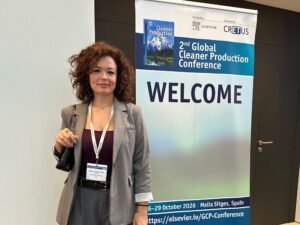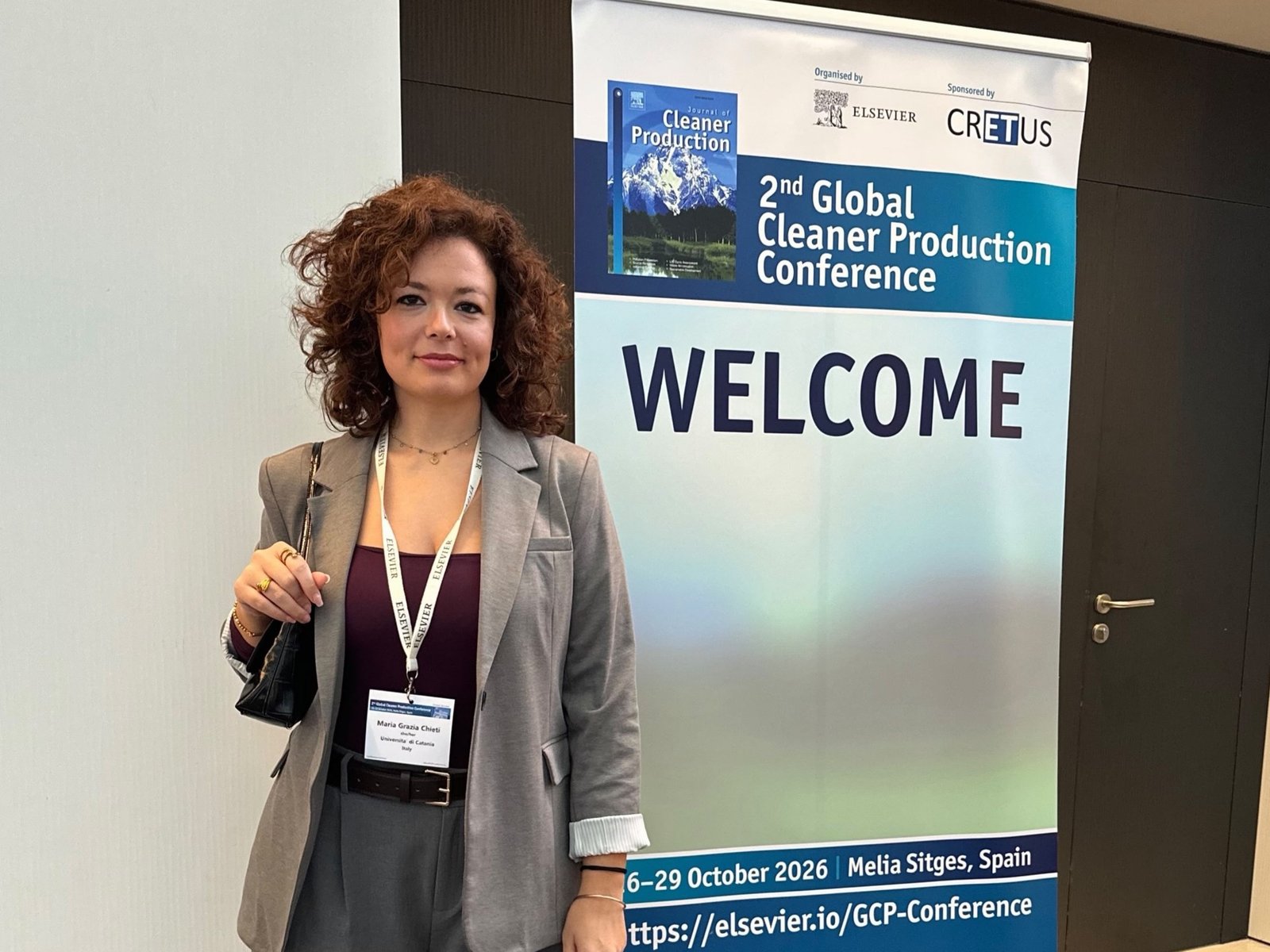
The WWEELab Research Group at Università Politecnica delle Marche (UNIVPM) participated in the 2nd Global Cleaner Production Conference (GCPC 2026), held from 26-29 October in Sitges, Spain. Organised by Elsevier, the international conference brought together researchers and professionals working on cleaner production, environmental sustainability, resource management and the circular economy. Representing LIFE TURBINES, Maria Grazia Chieti, PhD Researcher at WWEELab, presented scientific work connecting renewable energy recovery with the assessment of environmental impacts.
Her contribution, entitled “Energy recovery in water networks through Pump-as-Turbine (PAT) technologies and environmental impact assessment using LCA”, focused on an important technological opportunity within urban drinking water infrastructure. Pump-as-Turbine technology uses conventional pumps in reverse operating mode to recover hydraulic energy and generate electricity from pressure and flow. This approach is particularly relevant to water distribution networks, where pressure-reducing valves are commonly used to maintain safe operating conditions and can dissipate energy that could otherwise be recovered.
The presentation also addressed Life Cycle Assessment (LCA), a methodology used to evaluate the environmental impacts associated with a technology throughout its life cycle. Applying this perspective to energy recovery solutions helps researchers consider their broader environmental implications alongside their electricity-generation potential. This is particularly relevant to LIFE TURBINES, which seeks to make better use of existing water infrastructure while assessing the environmental performance of the technologies deployed.
LIFE TURBINES currently encompasses 13 pilot cases across Spain and Italy, demonstrating how micro-turbines installed in drinking water networks can convert pressure drops into renewable electricity. The project’s wider ambition is to support the development of more sustainable urban water and energy systems through solutions that can be adapted to different local conditions. Participation in GCPC 2026 provided an opportunity to share this research with the international scientific community and strengthen the connection between technological innovation, renewable energy recovery and environmental assessment. Co-funded by the European Union (LIFE Programme).